Canada unemployment rate by province, air quality and new corporations: weekly data summary, October 19, 2026
Air quality was low risk in 99.5% of hourly readings, unemployment fell over the year in 7 of 10 provinces but rose in Quebec, 1,441 new federal corporations in a week, and frost season is nearly over except near the coasts.
Published 2026-10-19 · OpenCanadaData
- Air quality was low risk (AQHI 1–3) in 99.5% of 19,793 hourly readings at 122 stations, October 12–18; Calgary had the most moderate-risk hours (14).
- Canada's unemployment rate was 6.5% in September 2026, up 0.1 point from August but 0.6 point below a year earlier; it fell in 7 of 10 provinces over the year.
- Quebec went the other way: unemployment rose from 5.7% to 6.0% and employment fell by 94,600 (−2.0%) in a year.
- 1,441 new federal corporations (still active) were incorporated October 5–11, below the previous four-week average of 1,524; 76.5% of recent ones list an Ontario office.
- 485 of 522 climate stations (92.9%) are past their typical first fall frost date; 26 of the 37 still waiting are in British Columbia.
Our second weekly summary. Last week's edition covered recalls, river levels, Edmonton rinks and inflation; this week we look at air quality, jobs, new businesses and frost. Every figure is calculated by script from our copies of the official files, with the cut-off stated in each section.
Update: 10 more vehicle recalls for last week
Our October 19 refresh of the Health Canada recalls portal added 10 Transport Canada notices dated October 15–16 that were not yet posted last week, raising the October 12–18 total from 33 to 43. They name Ford (3), Honda (2), and Toyota, Volvo, Tiffin, Hyundai, Prevost (one each).
Air quality: a clean week, with short spikes in Alberta and Ontario
We banded every hourly Air Quality Health Index reading in Environment and Climate Change Canada's real-time feed for October 12–18 (UTC), rounded to whole numbers as the index is published. Of 19,793 readings from 122 stations, 99.5% were low risk (1 to 3), and 95 stations never went above 3. Our copy of the feed has no Quebec stations.

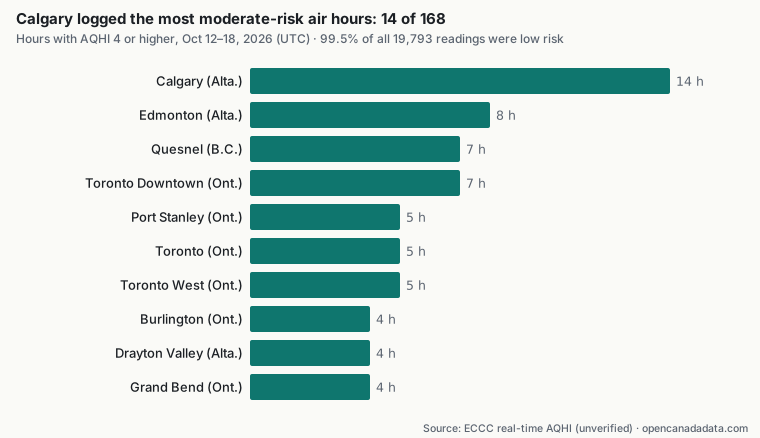
Moderate-risk hours (AQHI 4 to 6) clustered in southern Ontario (52 hours) and Alberta (33). Calgary's 14 fell between midday October 16 and midday October 17. Only Edmonton (3 hours) and neighbouring Sturgeon County (one hour) reached high risk (7 or more). Edmonton's peak of 11, at 2 p.m. MDT on October 13, was a single hour between low readings; real-time data are unverified, so brief spikes may reflect local events or data issues. Current readings: air quality page.
Jobs: unemployment lower than a year ago in most provinces
Statistics Canada's Labour Force Survey put the September 2026 unemployment rate at 6.5% (seasonally adjusted), against 6.4% in August and 7.1% a year earlier. Employment fell by 68,300 in the month but was 94,900 (+0.5%) above September 2025. With the employment rate flat at 60.6% and participation down from 65.2% to 64.8%, the lower jobless rate mostly reflects fewer people looking for work.

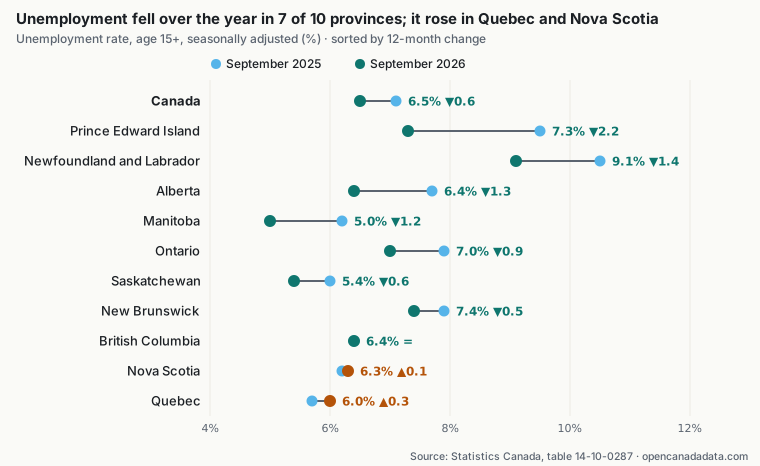
The largest declines were in P.E.I. (9.5% to 7.3%), Newfoundland and Labrador (10.5% to 9.1%), Alberta (7.7% to 6.4%) and Manitoba (6.2% to 5.0%). Alberta added the most jobs (75,700, +2.9%). In Quebec, 49,400 of the 94,600 jobs lost over the year disappeared in September alone. Provincial estimates have wide margins of error. More series: economy page.
New businesses: 1,300 to 1,800 federal incorporations a week
Corporations Canada's file of active federal (CBCA) corporations, retrieved October 18, runs to October 16. The latest complete week, October 5–11, had 1,441 incorporations, against 1,524 on average over the previous four weeks. Since June, weeks ranged from 1,307 (the Canada Day week of June 29) to 1,759 (week of August 31).

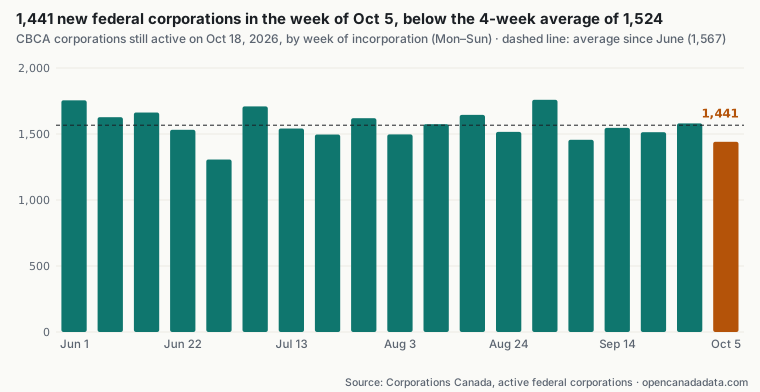
Filings follow the work week: 267 a day on weekdays versus 93 on weekends. The Thanksgiving week shows only 775 so far because the file lags; we will count it next week. In the last four weeks, 76.5% gave an Ontario registered office, 10.0% Quebec, 4.5% Alberta and 4.0% B.C. (CSV). Provinces run their own registries, so this covers federal filings only, and older weeks may be slightly undercounted because dissolved corporations drop out.
Frost: the season is almost over, except near the coasts
Using 1981–2010 normals for 522 stations, the typical first fall frost (the date by which frost had come in half of past years) has passed at 485 (92.9%). The 37 still ahead are mostly coastal or lakeside: 26 in B.C., 5 in Ontario, 4 in Nova Scotia and 2 in Newfoundland and Labrador; 18 reach it by November 1.
| Station | Prov. | Typical first fall frost | Frost-free days |
|---|---|---|---|
| Vancouver Int'l A | B.C. | November 10 | 237 |
| Victoria Int'l A | B.C. | November 5 | 211 |
| Toronto | Ont. | November 3 | 203 |
| Halifax Citadel | N.S. | October 31 | 182 |
| Halifax Stanfield Int'l A | N.S. | October 18 | 163 |
| Toronto Lester B. Pearson Int'l A | Ont. | October 16 | 168 |
| Montreal/Pierre Elliott Trudeau Intl A | Que. | October 12 | 165 |
| Winnipeg Richardson Int'l A | Man. | September 22 | 121 |
| Calgary Int'l A | Alta. | September 16 | 117 |
Normals are averages, not forecasts. The frost dates page also shows 10% and 90% dates for your nearest station.
What this means for you
- Sensitive to air pollution? Readings were low almost everywhere, but Calgary, Edmonton and the Toronto area had short moderate-risk spells; check the hourly AQHI before hard outdoor exercise.
- Job seekers: unemployment is clearly lower than a year ago in P.E.I., Newfoundland and Labrador, Alberta and Manitoba, while Quebec's market has softened.
- Starting a company? Federal incorporations are steady at about 1,567 a week; check existing names on our companies page first.
- Gardeners on the B.C. coast or in downtown Toronto and Halifax have a few weeks left (typical first frost at Vancouver airport: November 10); elsewhere, protect tender plants now.
- Vehicle owners: check the recalls page for the 10 late notices.
- Reuse figures, CSVs and charts with attribution; sources are listed on our data sources page.
Frequently asked questions
What is Canada's unemployment rate in September 2026?
6.5% (seasonally adjusted), according to Statistics Canada's Labour Force Survey, up from 6.4% in August and down from 7.1% in September 2025. Newfoundland and Labrador had the highest provincial rate (9.1%) and Manitoba the lowest (5.0%).
Was air quality good in Canada this week?
Mostly yes. From October 12 to 18, 99.5% of 19,793 hourly AQHI readings at 122 stations were in the low-risk band (1–3). 27 stations had at least one moderate-risk hour, and only Edmonton and Sturgeon County, Alberta, briefly reached high risk.
How many new federal corporations are created each week in Canada?
Between 1,307 and 1,759 a week since June 2026, counting corporations still active on October 18; the week of October 5–11 had 1,441. These are federal (CBCA) incorporations only; provinces run their own registries.
Has the first frost passed in Vancouver and Toronto?
Not typically yet. Based on 1981–2010 normals, the median first fall frost is November 10 at Vancouver airport and November 3 in downtown Toronto, but October 16 at Toronto Pearson airport. Normals are averages, not forecasts.
Methodology
Air quality: hourly AQHI observations from ECCC's real-time Datamart files, 2026-10-12T00:00 to 2026-10-18T23:00 UTC, 122 stations (83 with all 168 hours; at least 61 hours each). Values were rounded half up to whole numbers and banded as low (1–3), moderate (4–6), high (7–10) and very high (above 10); province is taken from each station's ECCC location code. Jobs: Statistics Canada table 14-10-0287-01, seasonally adjusted, population 15 and over, September 2026 compared with August 2026 and September 2025. New corporations: Corporations Canada's active CBCA corporations file (retrieved 2026-10-18), counted by incorporation date and registered-office province, Monday-to-Sunday weeks from June 1 to October 11, 2026; corporations dissolved since incorporation are not in the file. Frost: ECCC Canadian Climate Normals 1981–2010, 50% probability first fall frost date per station, compared with October 19, 2026. Recalls: Health Canada recalls dataset as refreshed on 2026-10-19, compared with the snapshot used for last week's summary.
Limitations and caveats
Correlation is not causation: lines that move together on a chart do not show that one caused the other. Company names are linked to profiles by exact normalized-name matching (plus province where available); different legal entities with similar names are not merged, and the same company may appear under several names. Figures describe what was reported to the government, not a finding of wrongdoing.
Sources and licences
- Air Quality Health Index (AQHI) observations — Environment and Climate Change Canada (MSC Datamart). Licence : Open Government Licence – Canada 2.0. Retrieved 2026-10-19.
Contains information licensed under the Open Government Licence – Canada. - Labour force characteristics, monthly (Table 14-10-0287-01) — Statistics Canada. Licence : Statistics Canada Open Licence. Retrieved 2026-10-18.
Source: Statistics Canada, Labour force characteristics, monthly (Table 14-10-0287-01). Reproduced and distributed on an "as is" basis with the permission of Statistics Canada. This data is available free of charge from Statistics Canada; this product is not endorsed by Statistics Canada. - Federal corporations (active, CBCA) — Corporations Canada (Innovation, Science and Economic Development Canada). Licence : Open Government Licence – Canada 2.0. Retrieved 2026-10-18.
Contains information licensed under the Open Government Licence – Canada. - Canadian Climate Normals 1981–2010 (station data, MSC Datamart) — Environment and Climate Change Canada (MSC Datamart). Licence : ECCC Data Servers End-use Licence. Retrieved 2026-10-18.
Data source: Environment and Climate Change Canada (provisional real-time hydrometric data), under the ECCC Data Servers End-use Licence. - Recalls and safety alerts — Health Canada. Licence : Open Government Licence – Canada 2.0. Retrieved 2026-10-19.
Contains information licensed under the Open Government Licence – Canada.
OpenCanadaData is an independent site, not affiliated with the Government of Canada. Original data is available free of charge from the official sources above. Report an error: support@opencanadadata.com
More insights
- Canada data this week: recalls, river levels, rinks and inflation (week of October 12, 2026)
- What 34,000 Health Canada recall notices show, and what they don't
- Canada's pollutant releases in 2024: where they come from
- Inflation and pump prices in Canada since 2018
- Drug licences meet pollutant reports: the companies in both federal files