Drug licences meet pollutant reports: the companies in both federal files
Only 44 of 3,587 drug product holders also report to the NPRI; most are Ontario and Quebec generic and personal-care manufacturers with modest releases.
Published 2026-10-18 · OpenCanadaData
Latest weekly summary: Canada data this week: recalls, river levels, rinks and inflation (week of October 12, 2026)
- 44 organizations appear in both the DPD and the 2024 NPRI.
- That is 1.2% of the 3,587 DPD product holders.
- Largest portfolio: Teva Canada Ltd. (1,486 products).
- Ontario (30) and Quebec (9) host most of them.
Two federal datasets describe very different sides of a company. Health Canada's Drug Product Database (DPD) lists the drugs a company is authorized to sell. Environment and Climate Change Canada's National Pollutant Release Inventory (NPRI) lists what its facilities release into the environment. On this site the two are linked through company profiles, which makes it possible to ask a simple question: which organizations appear in both?
44 organizations appear in both files
Out of 3,587 organizations with at least one DPD product and 2,754 organizations reporting to NPRI for 2024, exactly 44 matched in both under our conservative rules: the same normalized name and, where both sources give one, the same province. That is about 1.2% of DPD companies. The overlap is small because most DPD product holders are importers, distributors or foreign manufacturers with no Canadian plant large enough to cross NPRI reporting thresholds. Many large drug makers also hold their products under a different legal entity from the one that runs their plants.
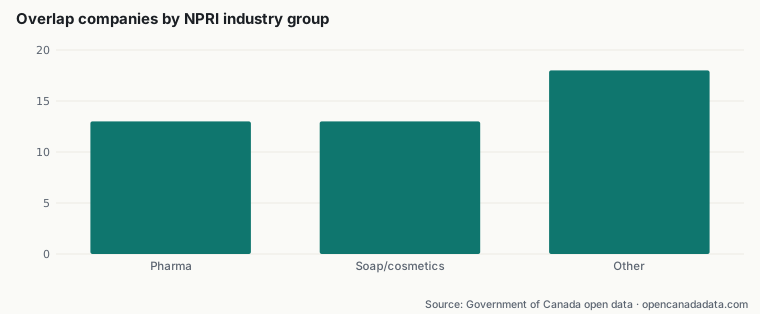
Most overlap companies are based in Ontario (30) or Quebec (9), the two hubs of Canada's pharmaceutical and personal-care manufacturing. By NPRI industry, 13 are pharmaceutical manufacturers and 13 make soaps, cleaning compounds or toilet preparations.
Big product portfolios, modest releases
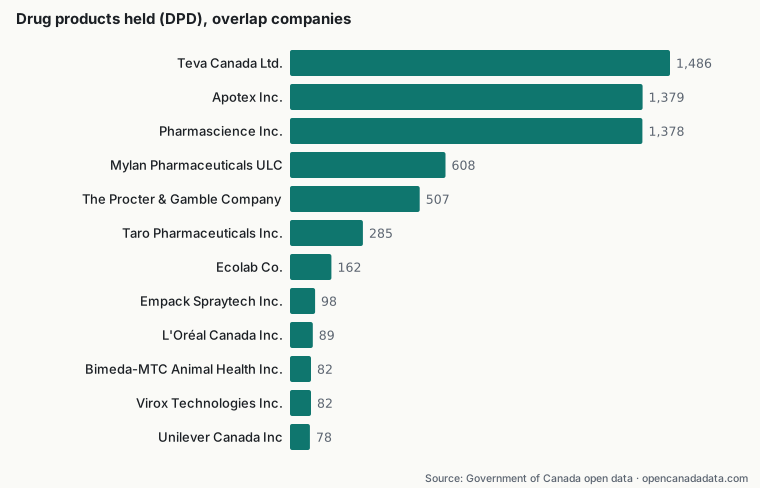
Generic drug manufacturers top the list by product count. Teva Canada Ltd. holds 1,486 DPD products, Apotex Inc. 1,379 and Pharmascience Inc. 1,378. Together, the 44 overlap companies hold 6,648 DPD products. Their reported releases are small next to heavy industry: together they reported about 2,289 tonnes in 2024, and 12 of them reported releases that round to zero tonnes. Their NPRI reports may cover substances reported in grams, transfers for disposal or recycling, or releases below one kilogram.
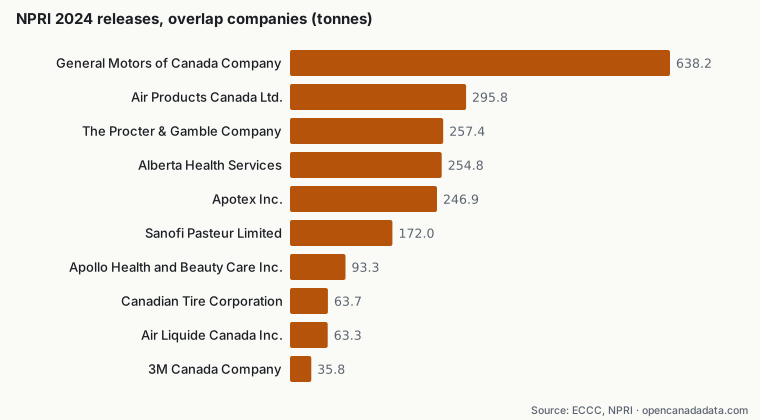
The overlap companies with the largest reported releases are mostly not drug makers in the usual sense. General Motors of Canada Company (638 t) and Air Products Canada Ltd. (296 t) appear in the DPD with only 1 and 6 product(s) respectively, alongside a core business in another industry (motor vehicle gasoline engine and engine parts manufacturing; industrial gas manufacturing).
| Company | Prov. | DPD products | NPRI facilities | NPRI t (2024) |
|---|---|---|---|---|
| Teva Canada Ltd. | ON | 1,486 | 2 | 12.06 |
| Apotex Inc. | ON | 1,379 | 3 | 246.88 |
| Pharmascience Inc. | QC | 1,378 | 1 | 14.87 |
| Mylan Pharmaceuticals ULC | ON | 608 | 1 | 0.17 |
| The Procter & Gamble Company | ON | 507 | 1 | 257.39 |
| Taro Pharmaceuticals Inc. | ON | 285 | 1 | 2.11 |
| Ecolab Co. | ON | 162 | 1 | 0.77 |
| Empack Spraytech Inc. | ON | 98 | 1 | 0.00 |
| L'Oréal Canada Inc. | QC | 89 | 1 | 0.00 |
| Bimeda-MTC Animal Health Inc. | ON | 82 | 1 | 0.00 |
| Virox Technologies Inc. | ON | 82 | 1 | 0.00 |
| Unilever Canada Inc | ON | 78 | 2 | 14.58 |
| ZEP Manufacturing of Canada | AB | 68 | 1 | 0.74 |
| Apollo Health and Beauty Care Inc. | ON | 67 | 1 | 93.28 |
| Laboratoire Atlas. Inc. | QC | 39 | 1 | 0.00 |
How to read this
Being in both datasets is neither good nor bad. It simply shows that a company both sells regulated health products and operates a facility large enough to report to NPRI. A product count reflects portfolio size, including many strengths and formats of the same molecule, not sales volume. NPRI tonnages are facility estimates under federal reporting rules.
A closer look: how concentrated is the drug product market?
The DPD records in our copy that are linked to a company profile total 58,137 products. Holdings are very uneven. The median company holds just 2 products, 1,242 companies hold exactly one, and the ten largest holders together account for 17% of all products. The 44 companies that also report to NPRI hold 11% of all linked DPD products, far more than their 1.2% share of companies would suggest. That fits the picture of a few large domestic manufacturers with extensive generic portfolios and Canadian plants.
Product counts are a crude measure. A single molecule sold in five strengths and two dosage forms can appear as ten products, and cancelled or dormant products remain in the database. Still, the pattern is consistent: companies with Canadian manufacturing sites tend to hold many authorizations, while most of the long tail of DPD holders have no presence in the pollutant inventory at all.
Explore the data yourself
Every figure in this article can be checked. Each chart has a CSV download built from the same script output, and the sources section below links to the official datasets with the date we retrieved them. Browse the underlying records on the product licences page, open any company profile to see all the records linked to it and how each one was matched, or use the corrections form if you spot an error.
Methodology
We selected every company profile that has at least one Drug Product Database record and at least one 2024 NPRI facility record. Records are attached to profiles only by deterministic rules: an exact normalized name (legal forms such as Inc./Ltd./Ltée removed, accents and punctuation stripped) plus the same province, or a nationally unique exact name when the source gives no province. Fuzzy matches are never merged. As a result, the 44 companies are a lower bound: a company whose DPD holder name differs from its NPRI name (for example a parent versus an operating subsidiary) is not counted. DPD counts include every product status in our copy (marketed, approved, dormant, cancelled).
Limitations and caveats
Correlation is not causation: lines that move together on a chart do not show that one caused the other. Company names are linked to profiles by exact normalized-name matching (plus province where available); different legal entities with similar names are not merged, and the same company may appear under several names. Figures describe what was reported to the government, not a finding of wrongdoing.
Sources and licences
- Drug Product Database (DPD) — Health Canada. Licence : Open Government Licence – Canada 2.0. Retrieved 2026-10-18.
Contains information licensed under the Open Government Licence – Canada. - National Pollutant Release Inventory (NPRI) – facility data, 2024 — Environment and Climate Change Canada. Licence : Open Government Licence – Canada 2.0. Retrieved 2026-10-18.
Contains information licensed under the Open Government Licence – Canada.
OpenCanadaData is an independent site, not affiliated with the Government of Canada. Original data is available free of charge from the official sources above. Report an error: support@opencanadadata.com
More insights
- Canada data this week: recalls, river levels, rinks and inflation (week of October 12, 2026)
- What 34,000 Health Canada recall notices show, and what they don't
- Canada's pollutant releases in 2024: where they come from
- Inflation and pump prices in Canada since 2018
- Do vehicle recalls track gas prices? A lesson in reading two lines